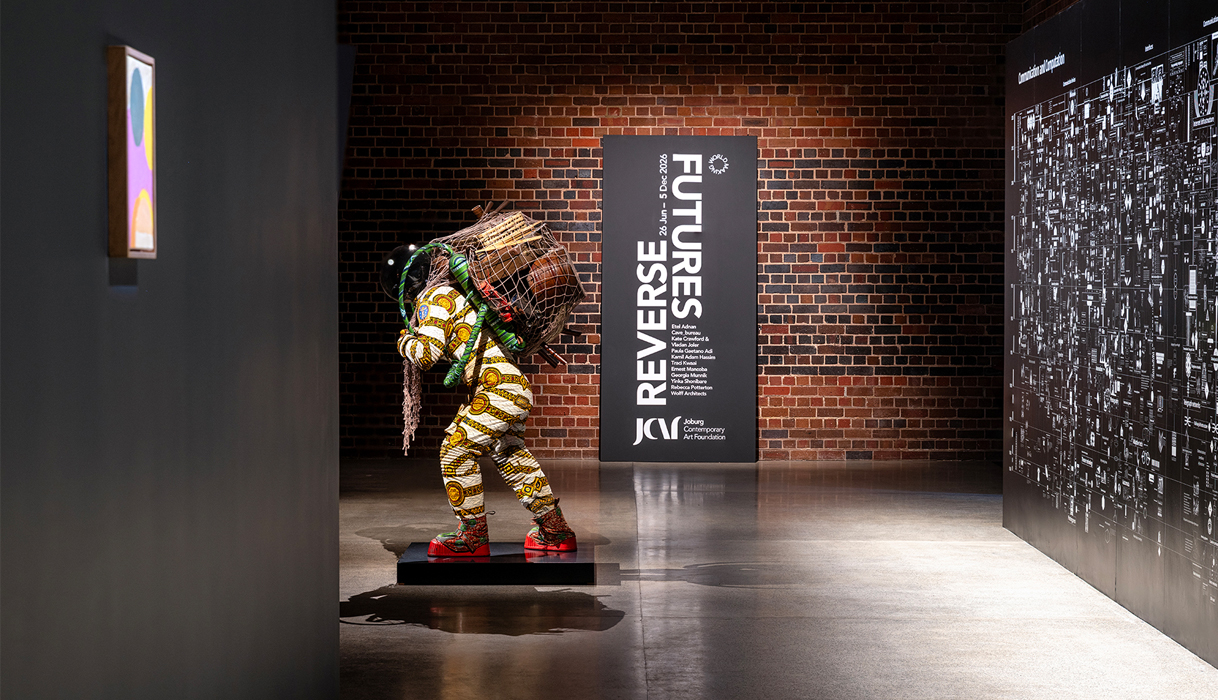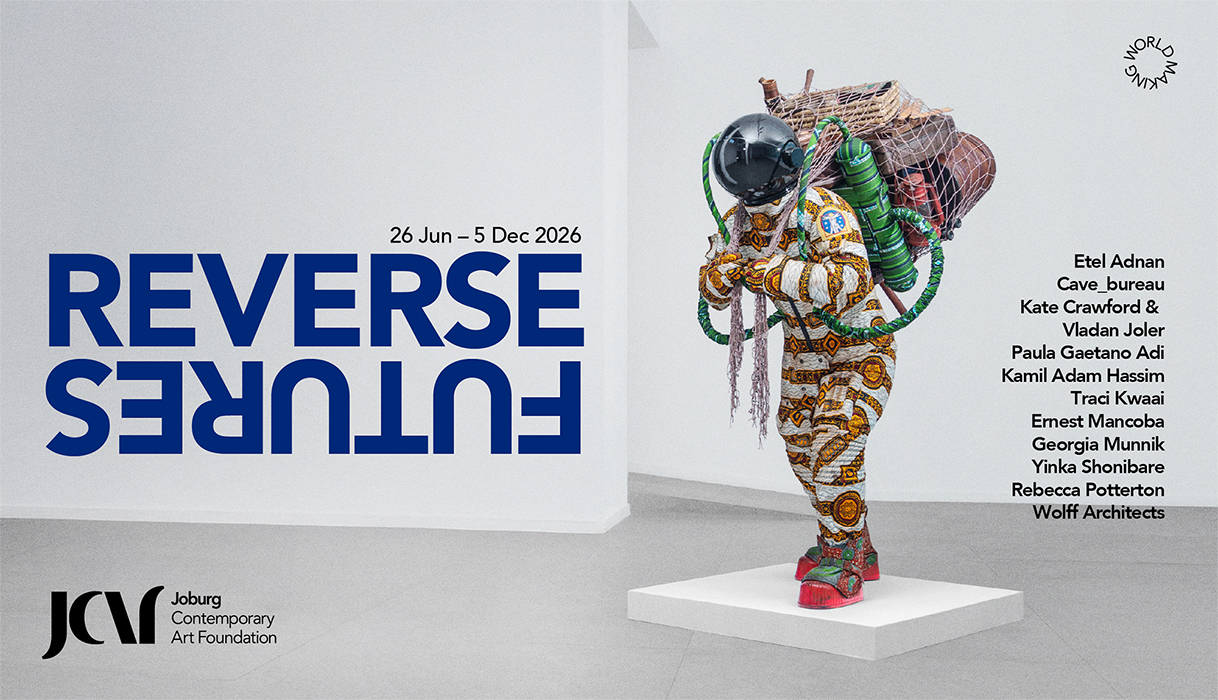
The final exhibition in the Worldmaking series, Reverse Futures, opened 26 June. The exhibition centres on ideas of the future from the Global South, where past, present and future are interconnected. Grounded in historical research, artists’ lived experiences, community narratives and Indigenous knowledge systems, the exhibition examines how the effects of colonialism, migration and technological change continue to shape both the present and our visions of what lies ahead.
The title Reverse Futures is derived from Nairobi-based architectural practice Cave_bureau who coined the term ‘reverse futurism’ to address the impact and effects of colonialism in Africa and specifically Kenya, explaining that “for the future to exist we need to undo the mistakes of the past” [Mohamed, B. (2025). “Design in Deep Time”, in Future Observatory Journal No. 3, https://fojournal.org/case-study/cave-bureau-profile-more-than-human/]. Reverse Futurism refers to remedial acts that address this history and the present at the same time, while making pathways of healing in the midst of colonial and ongoing neocolonial affective and administrative architectures [Karanja, K. & Mutegi, S. (2023). Cave Bureau, The Architect’s Studio. Humlebaek, DK: Louisiana Museum of Modern Art, pp. 52, 84, 105].
Featured artists: Etel Adnan, Cave_bureau, Kate Crawford and Vladan Joler, Paula Gaetano Adi, Kamil Adam Hassim, Traci Kwaai, Ernest Mancoba, Georgia Munnik, Yinka Shonibare, and special projects by Wolff Architects and Rebecca Potterton.
Make a booking to visit the exhibition.
Read the publications: Reverse Futures Reader and Reverse Futures Exhibition Guide.
Explore the virtual tour and find out more about the exhibition below.
This exhibition aims to address the world of tomorrow from the present, while acknowledging the past as integral to any conception of the future. Germane to this is the role of technology and how it will evolve and affect our lives, as well as how artists, architects and designers think about our world and its future. The artworks reflect on migration, memory, ecology, the cosmos and power, inviting viewers to reconsider the role of technology. Such situated approaches challenge dominant narratives of progress, opening space for alternative ways of imagining the planet’s future without losing sight of ongoing injustices, including how they may be reproduced beyond Earth. These themes unfold through immersive and unexpected encounters, as visitors navigate the exhibition through three interconnected sections: Space, Time and Place.

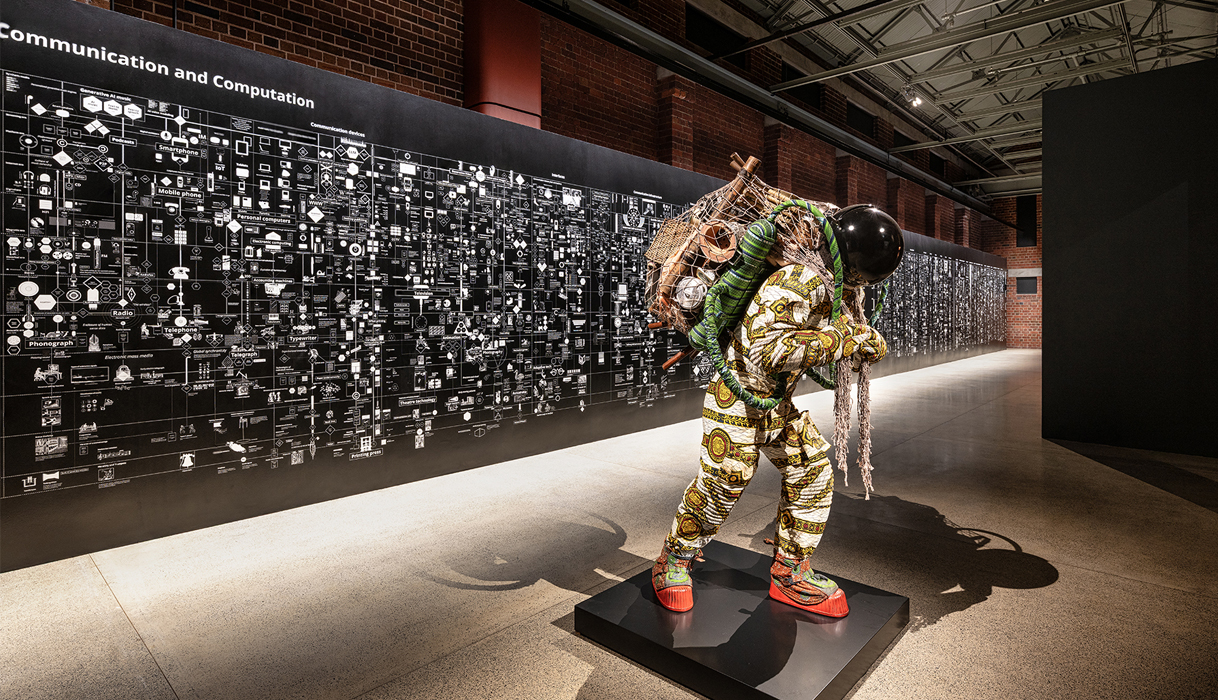
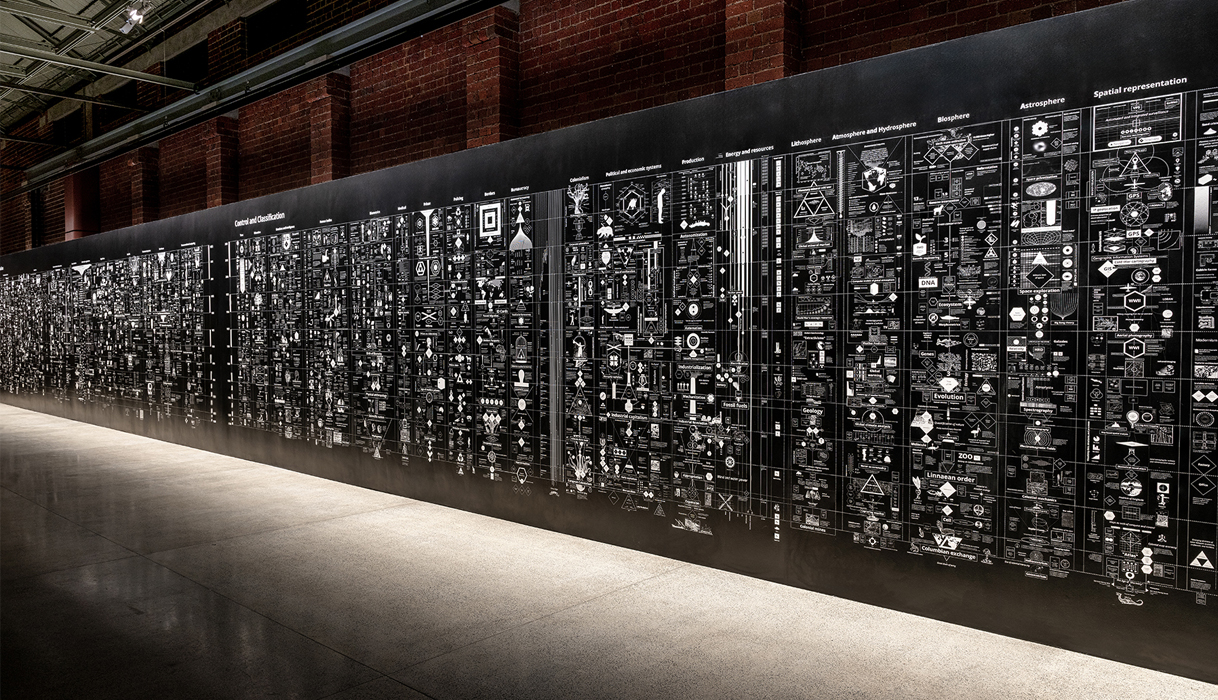
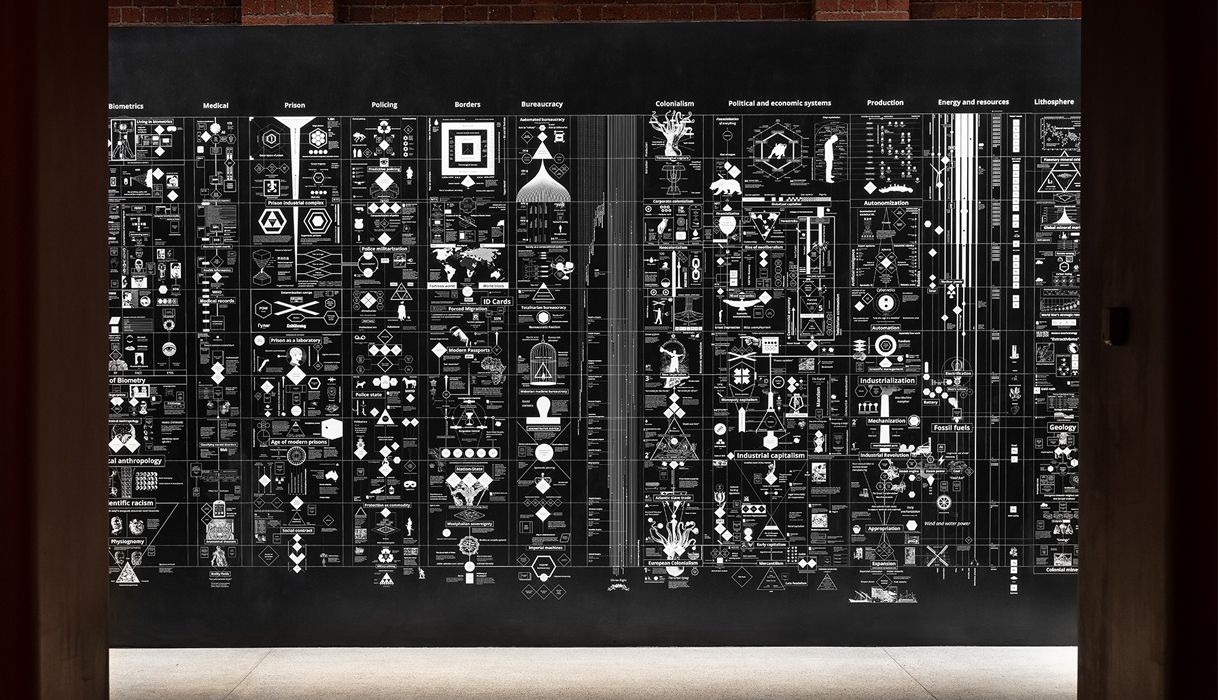
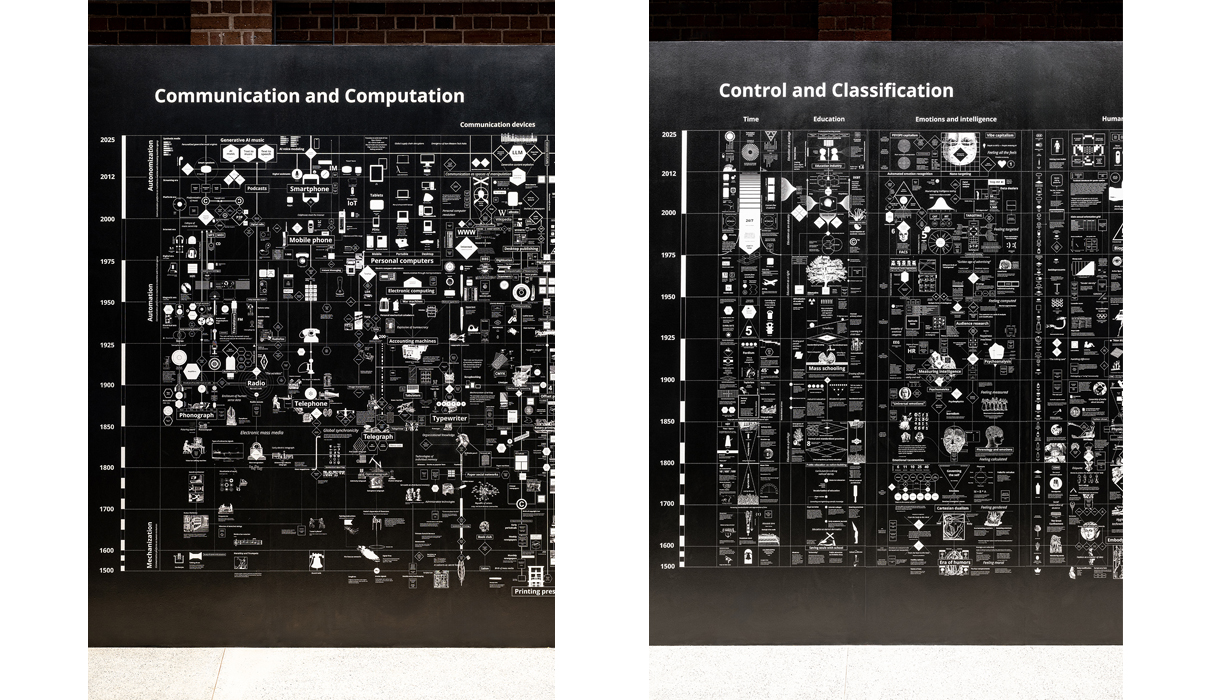
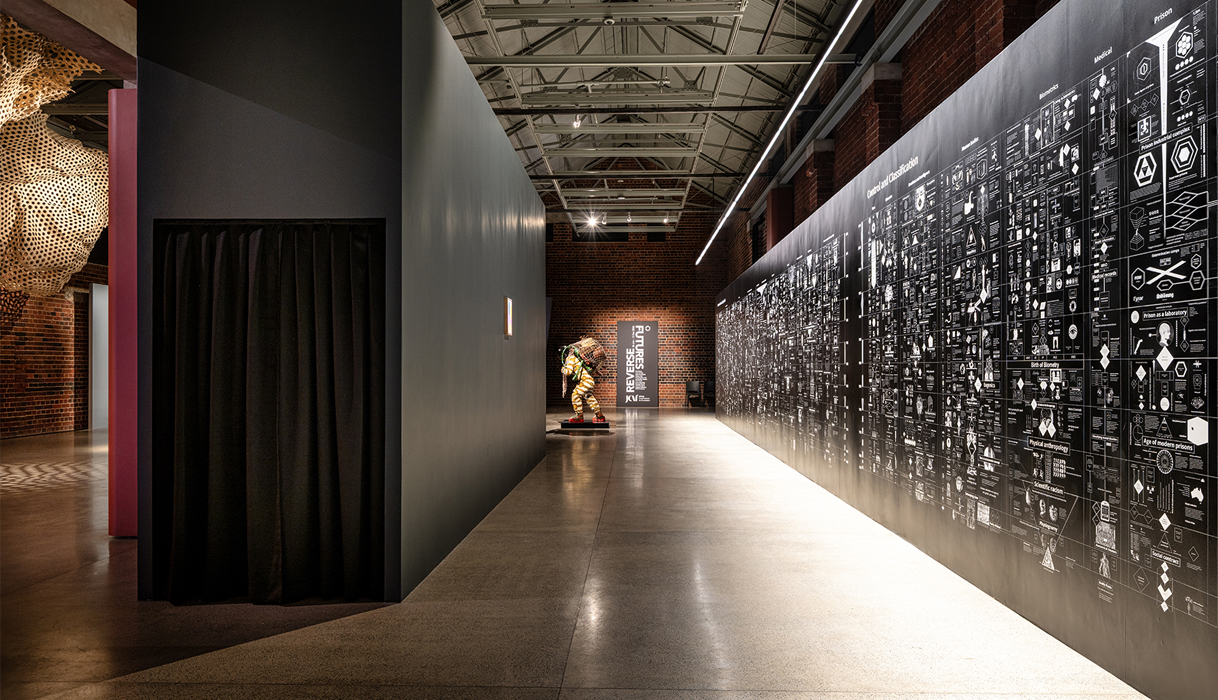
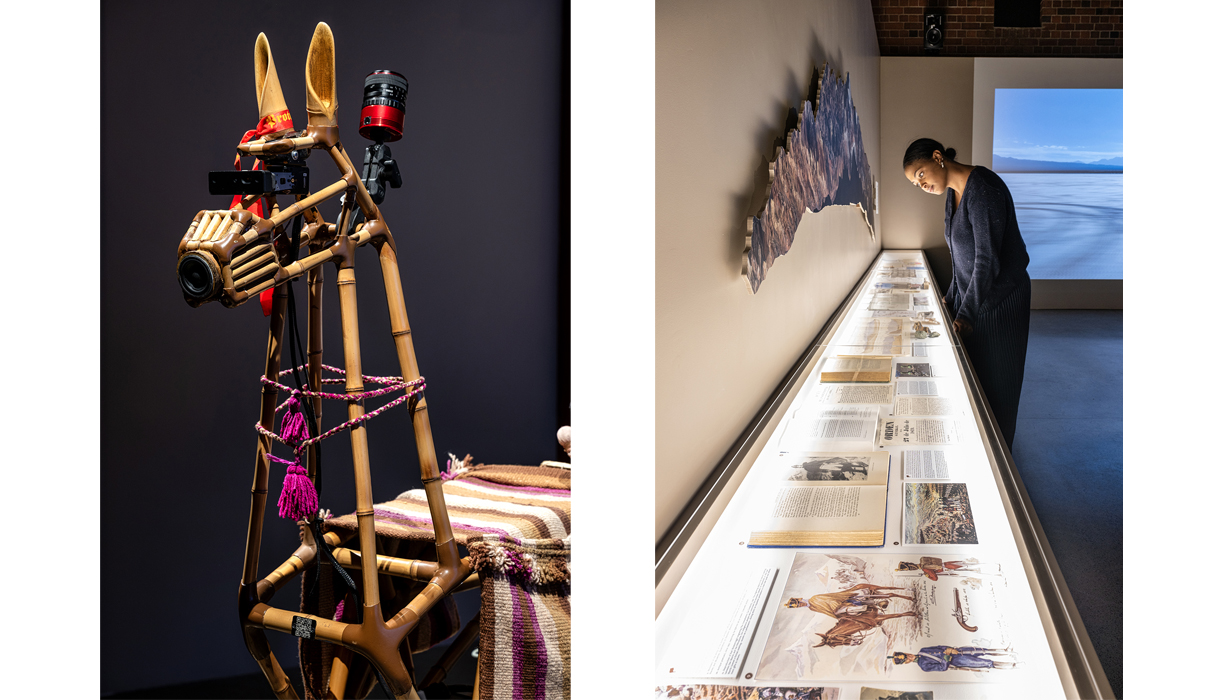
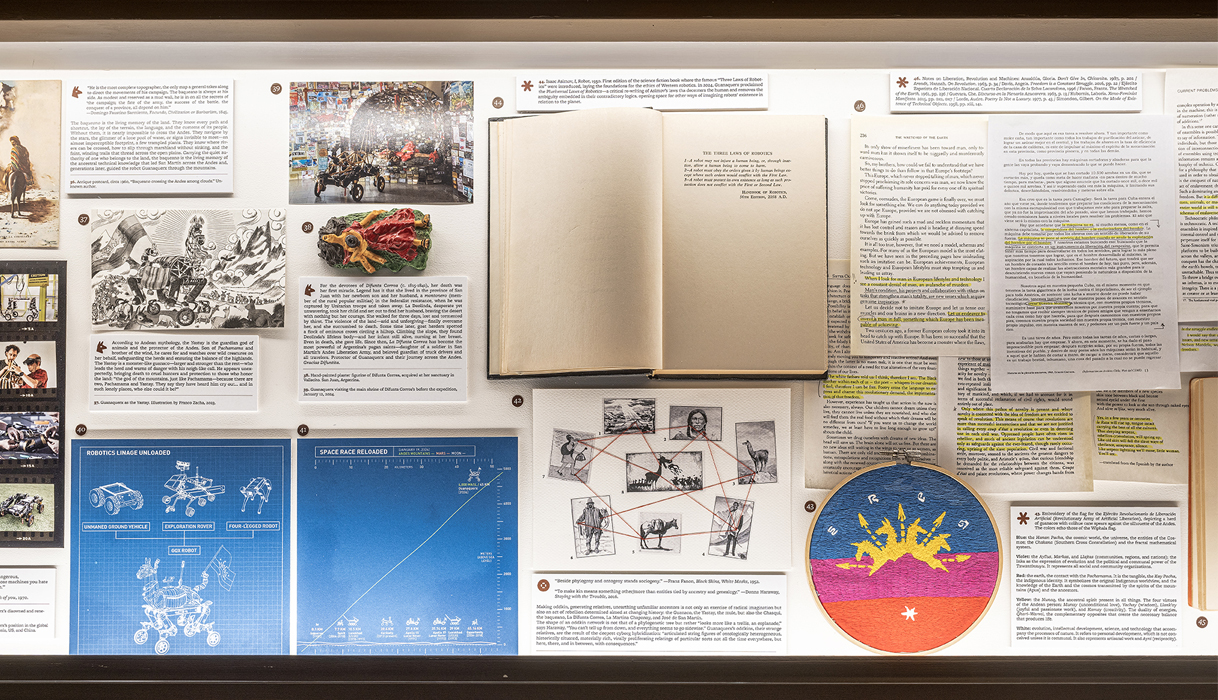
Central to the exhibition is Kate Crawford and Vladan Joler’s epic, visual-data installation, Calculating Empires (2023), that runs the length of the gallery space and traces the imperial pathways of power since the 1500s across systems of power like colonialism, militarisation and automation. Through hundreds of handcrafted illustrations and texts that draw relationships between today’s empires and those of the past, Crawford and Joler visualise how technical and social structures have co-evolved over the centuries.
Installation views of Calculating Empires: A Genealogy of Technology and Power since 1500 (2023) by Kate Crawford and Vladan Joler. © Kate Crawford and Vladan Joler.
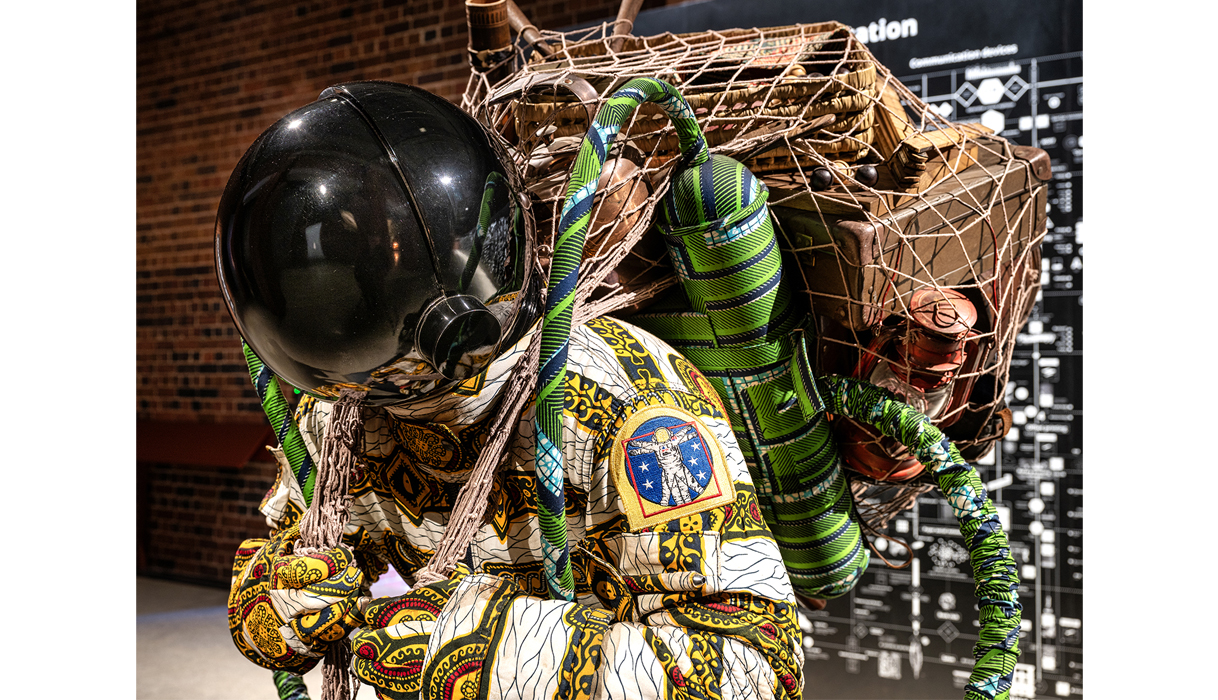
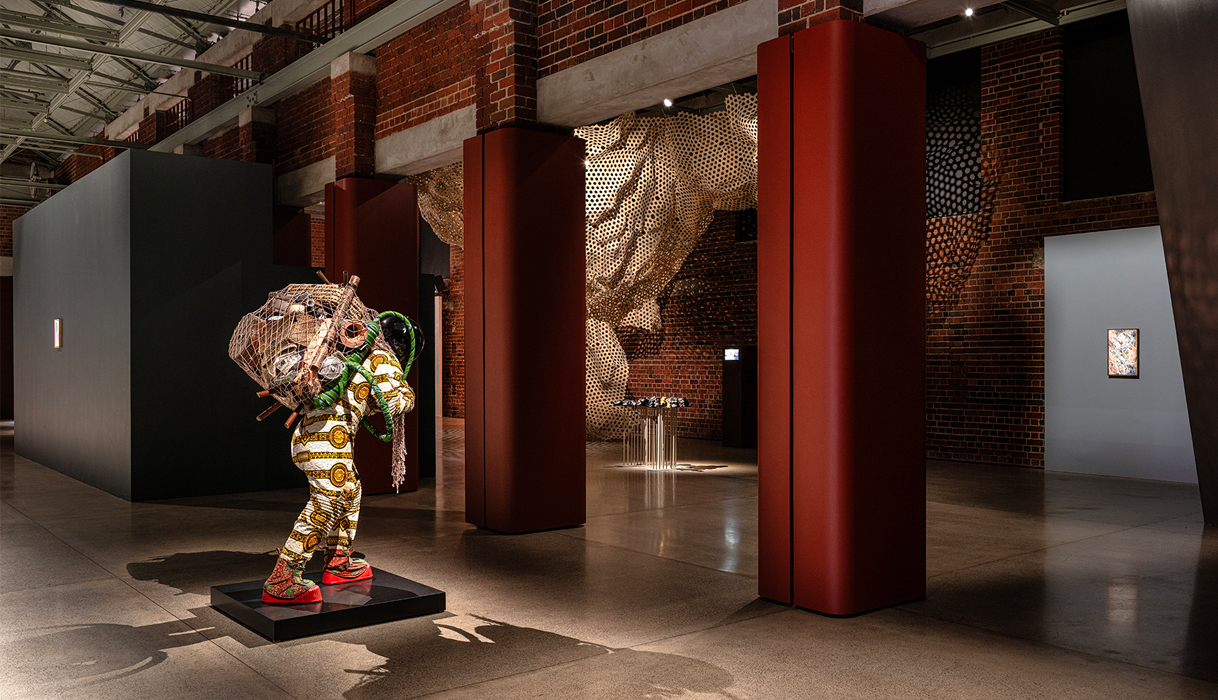
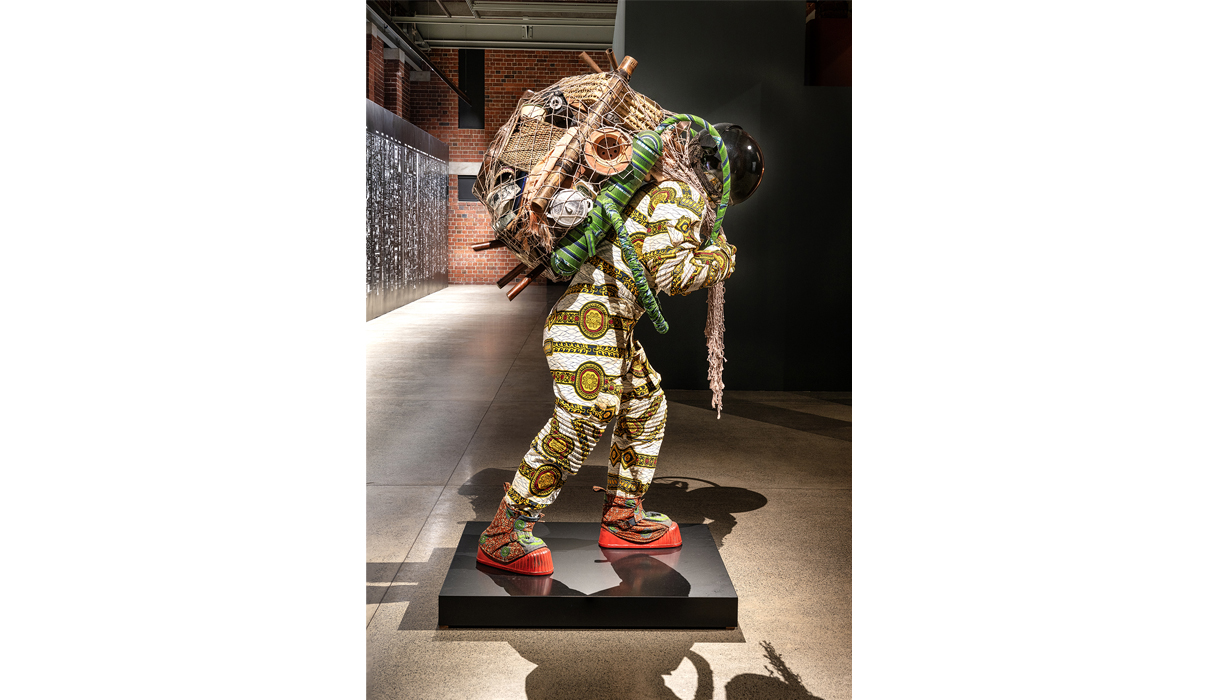
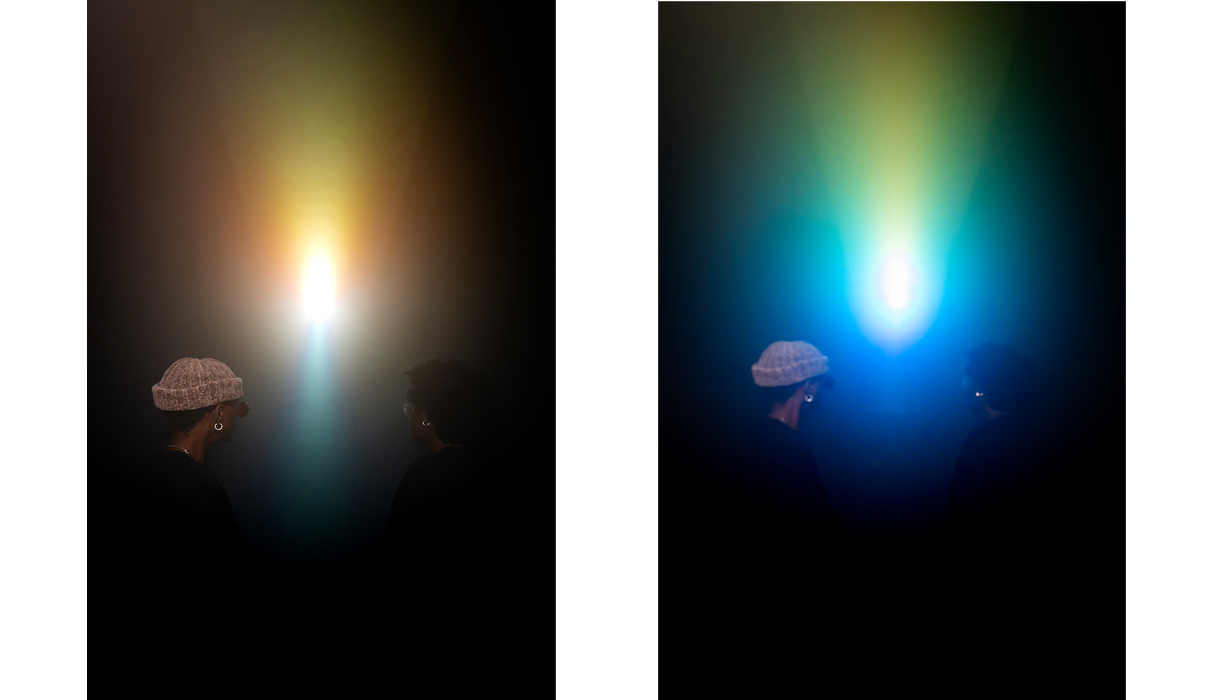
The first section of the exhibition brings together three artworks that engage with the idea of space and astronomy through three distinct mediums: painting, sculpture and installation. The three works are conceptually connected by the notion that Indigenous knowledges are bound to contemporary realities such as migration, mapping and memory. Space is a metaphor not for conquest, but for invention, imagination and creativity.
Installation views of Space showing Yinka Shonibare, Refugee Astronaut X (2024). © Yinka Shonibare; Etel Adnan, Satellites 27 (2020). © 2020 Etel Adnan | DALRO; and Kamil Adam Hassim, Event Horizon (2026). © Kamil Adam Hassim.
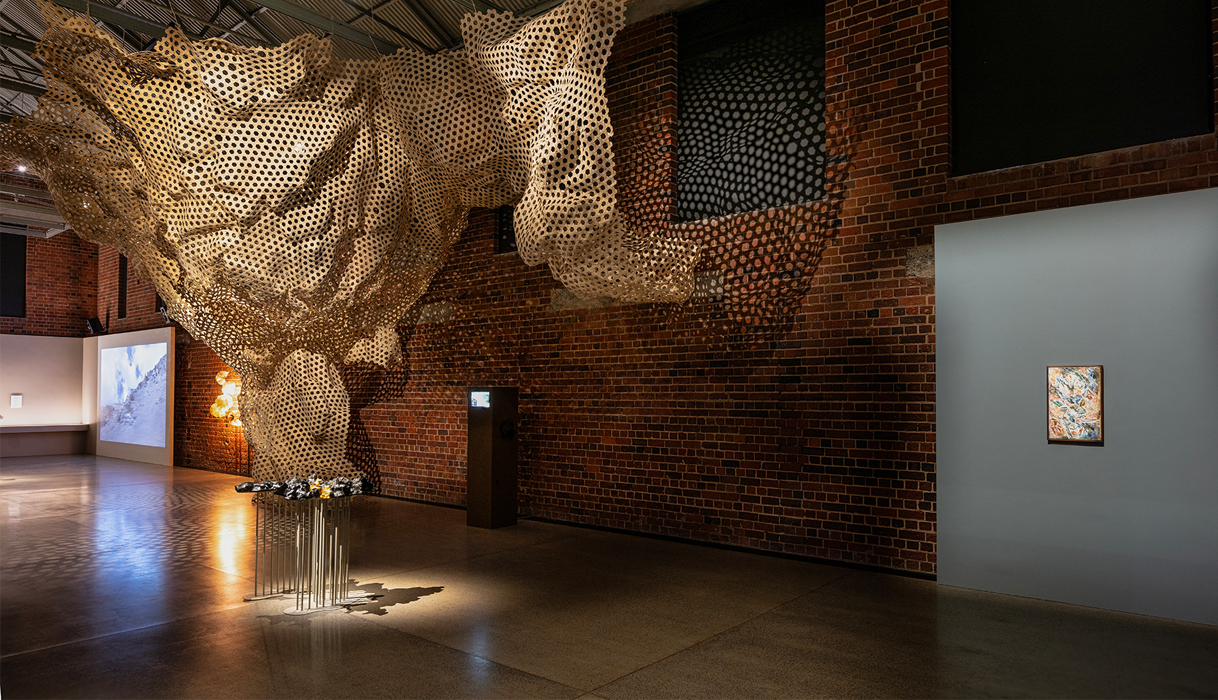
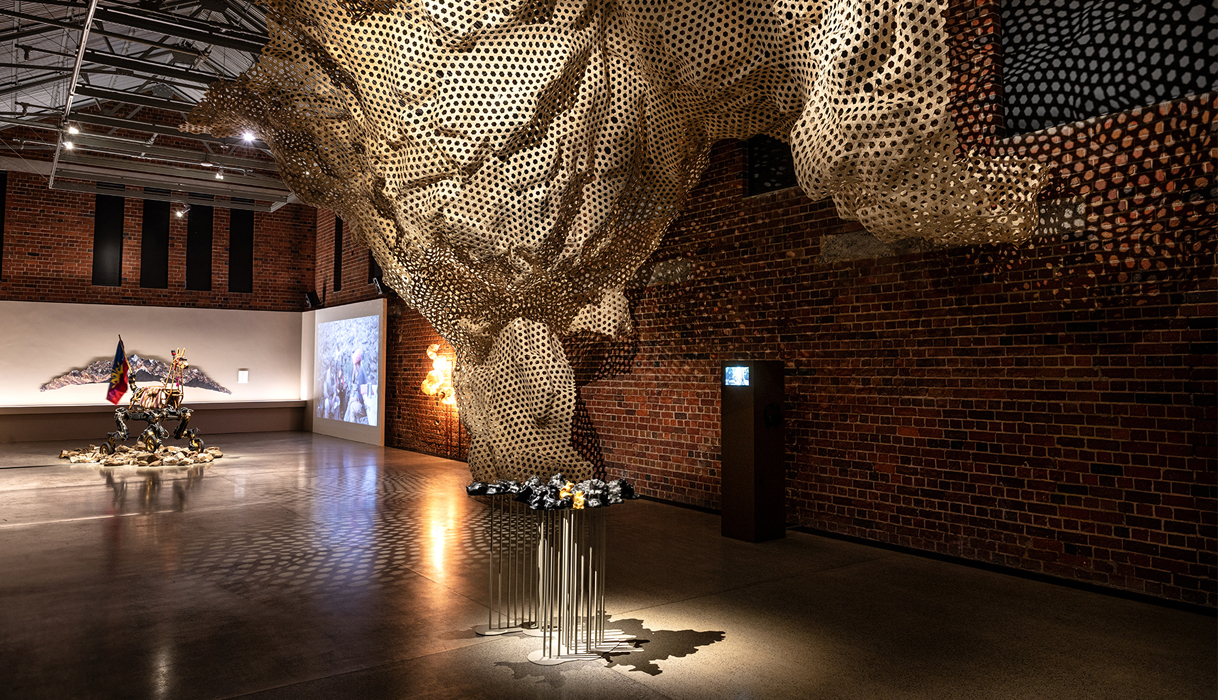
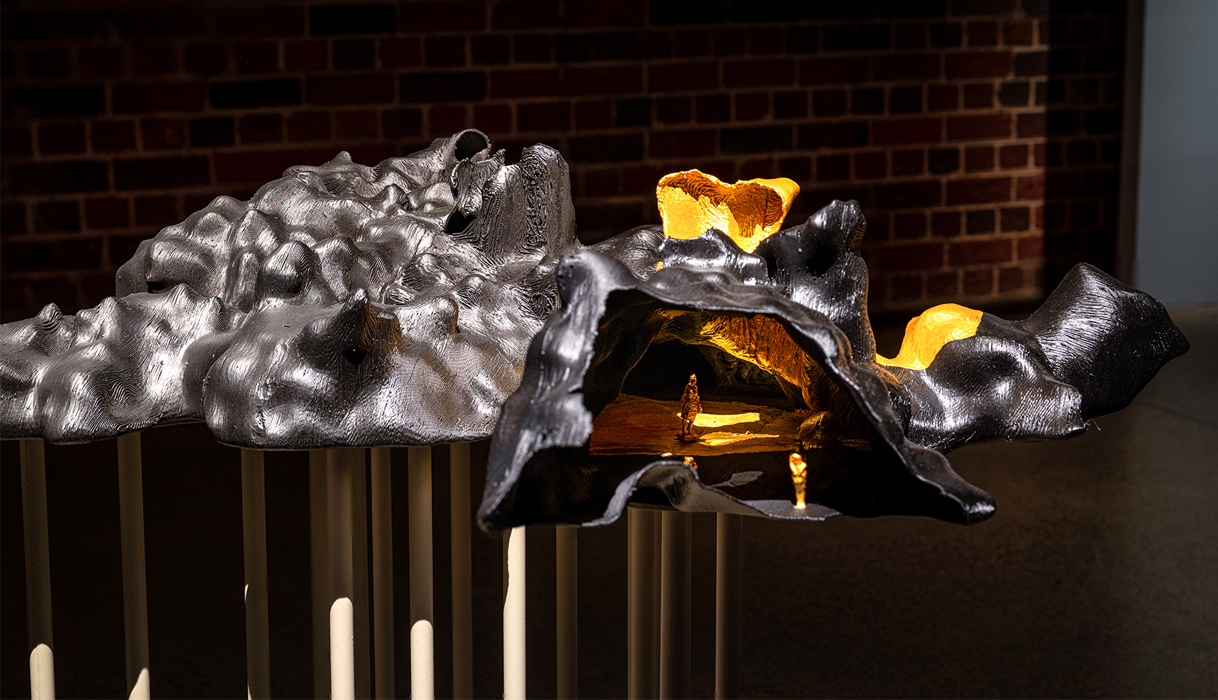
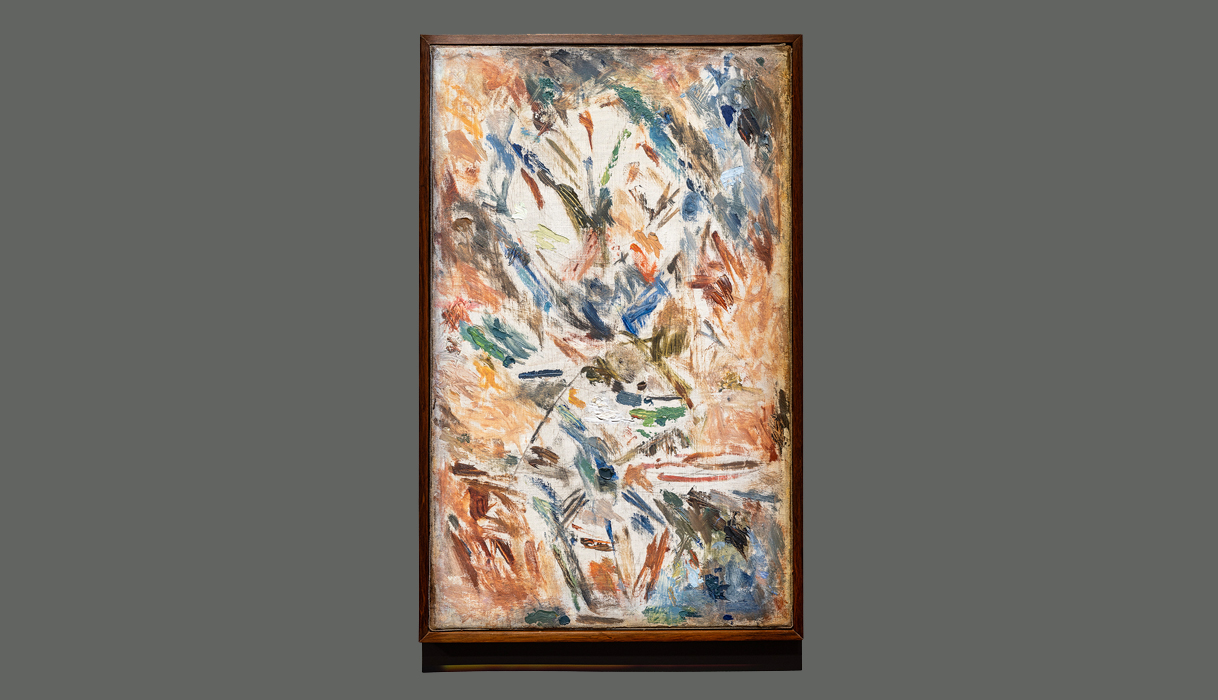
The second section of the exhibition addresses time by contrasting two works: an installation showing a Kenyan cave and a modernist painting. The formal characteristics of each work – marks, weaving and traces – are uncanny in their similarity. There is a beautiful reflexive visual connection between the weave of the cave installation and the ‘weave’ marks of the painting. But these works are also signifiers of the historically contested terrains of race and slavery, modernity and African identity.
Installation views of Time showing Cave_bureau’s installation Shimoni Slave Cave (2022–2023), accompanying video Anthropocene Museum 2.0: Shimoni Slave Caves (2021) and scale model Shimoni Slave Cave (2026). © Cave_bureau; and Ernest Mancoba, Untitled (1971). © Ferlov Mancoba Foundation / Galerie Mikael Andersen.
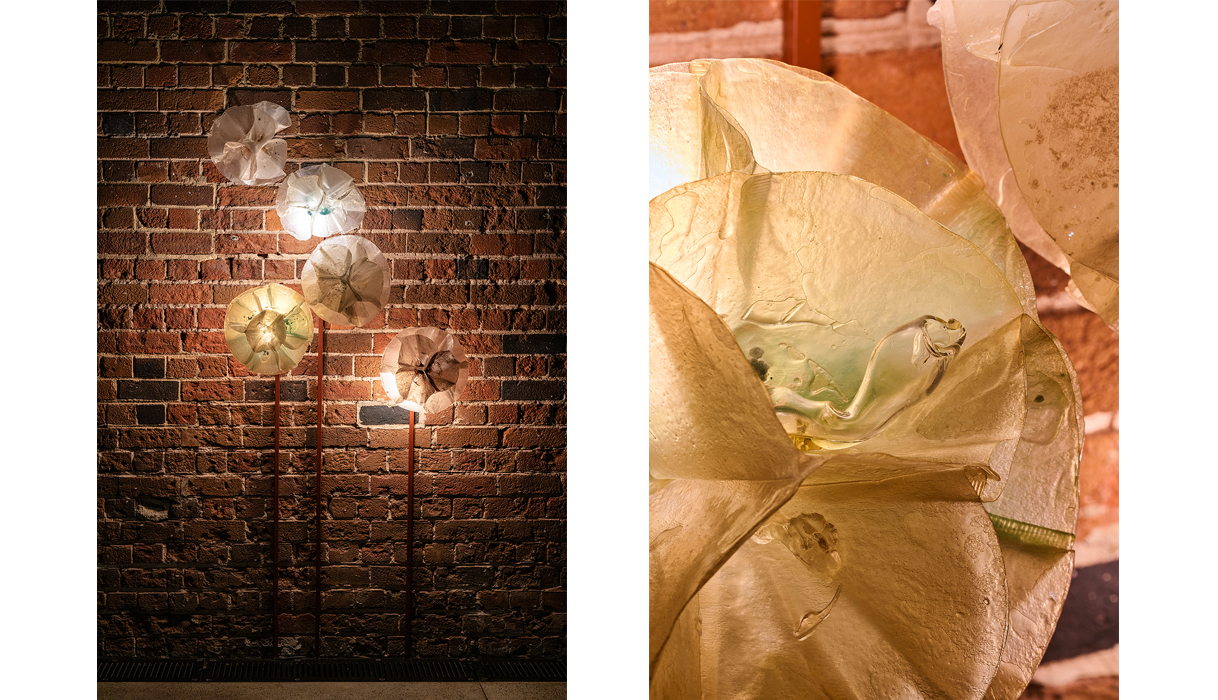
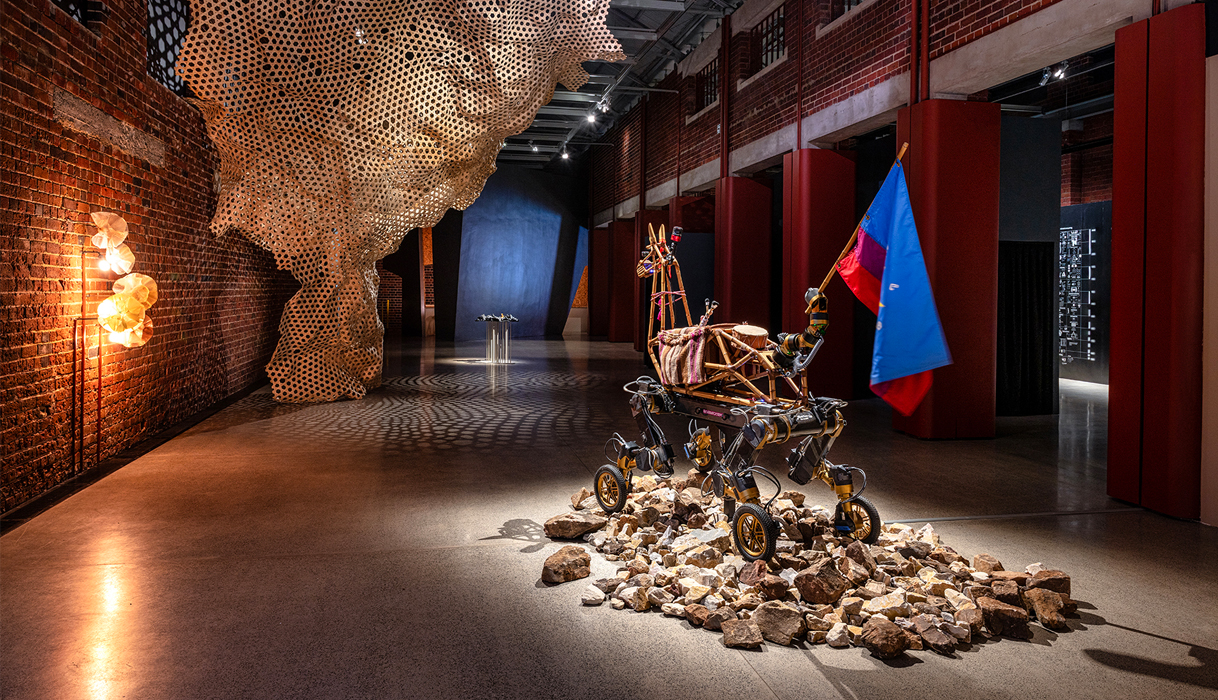
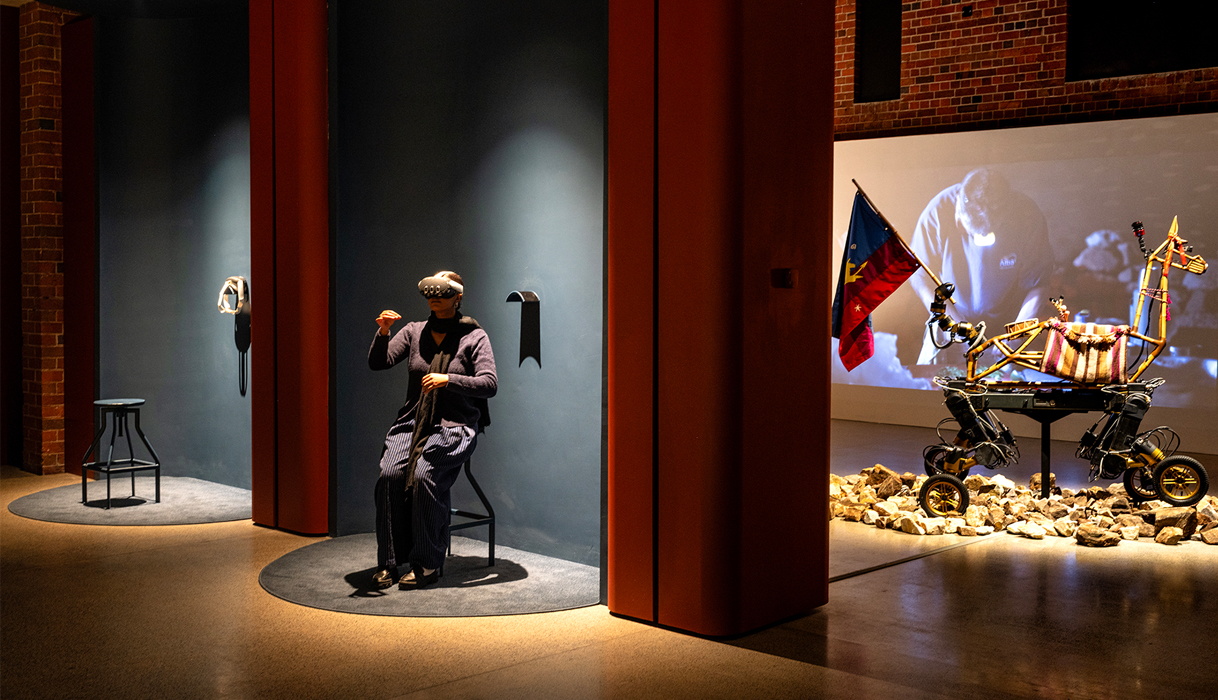
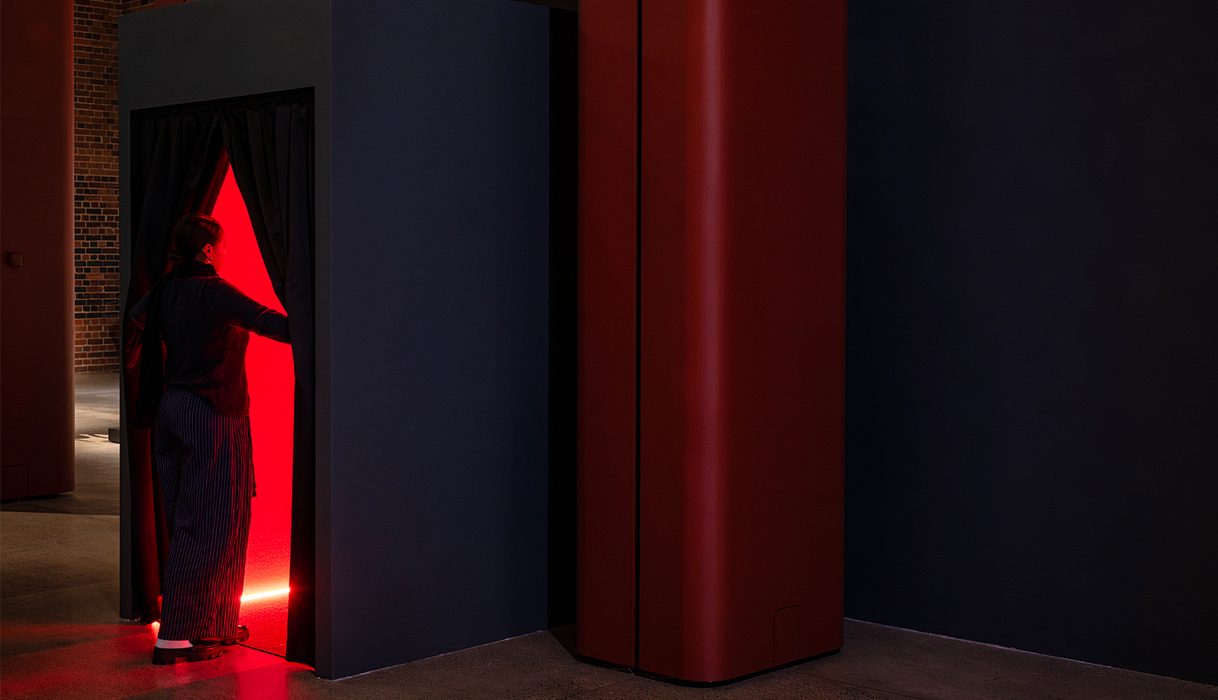
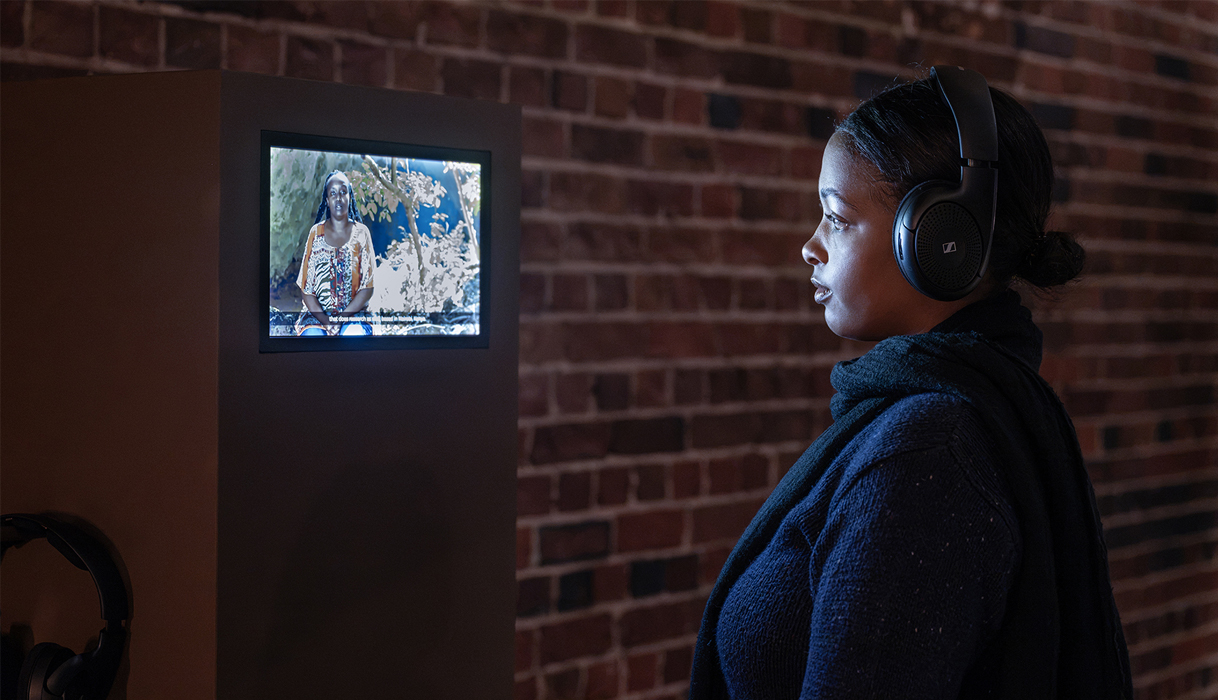
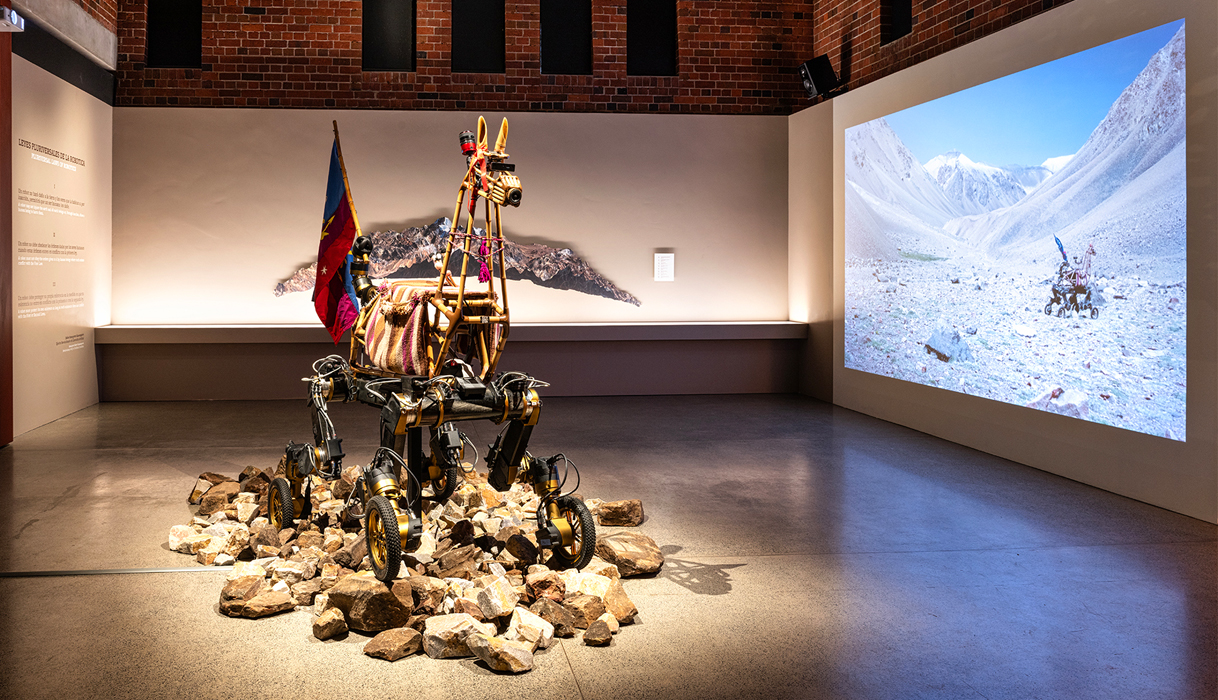
The last section of the exhibition uses technology in poetic ways to think about place, community and storytelling. Technology can teleport us to imagined worlds, scents can evoke feelings, and historical events can be reimagined empathetically. Each of the three artworks in this section conveys a message concerning the environment.
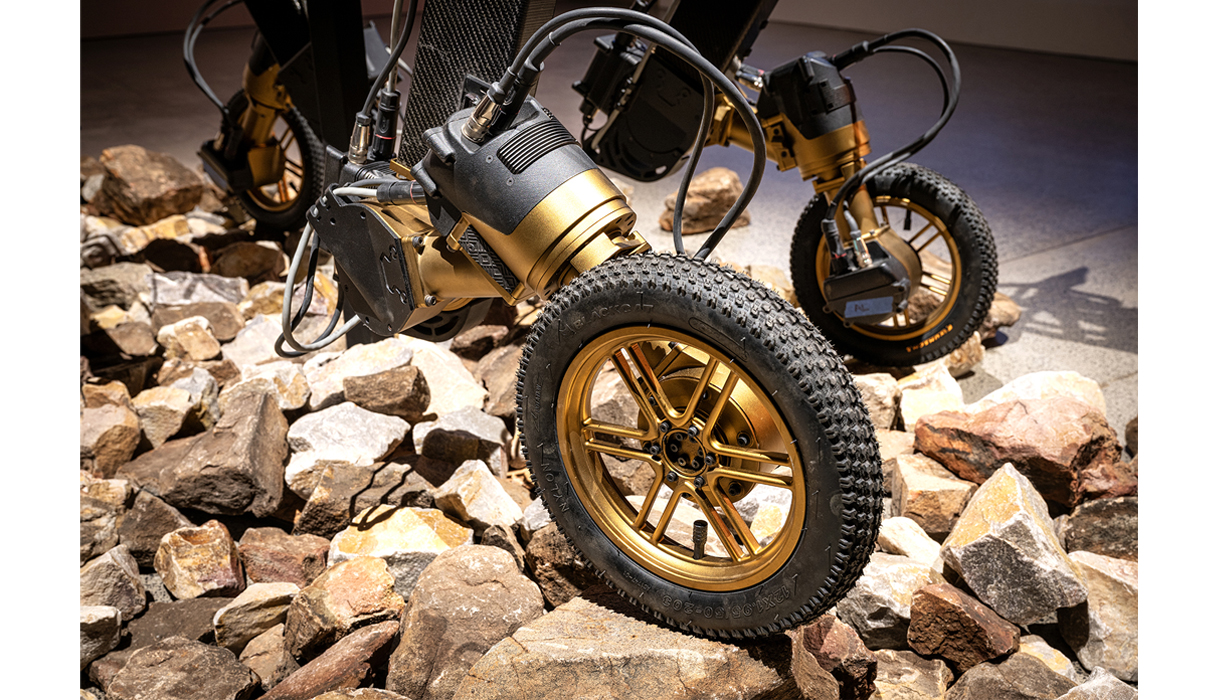
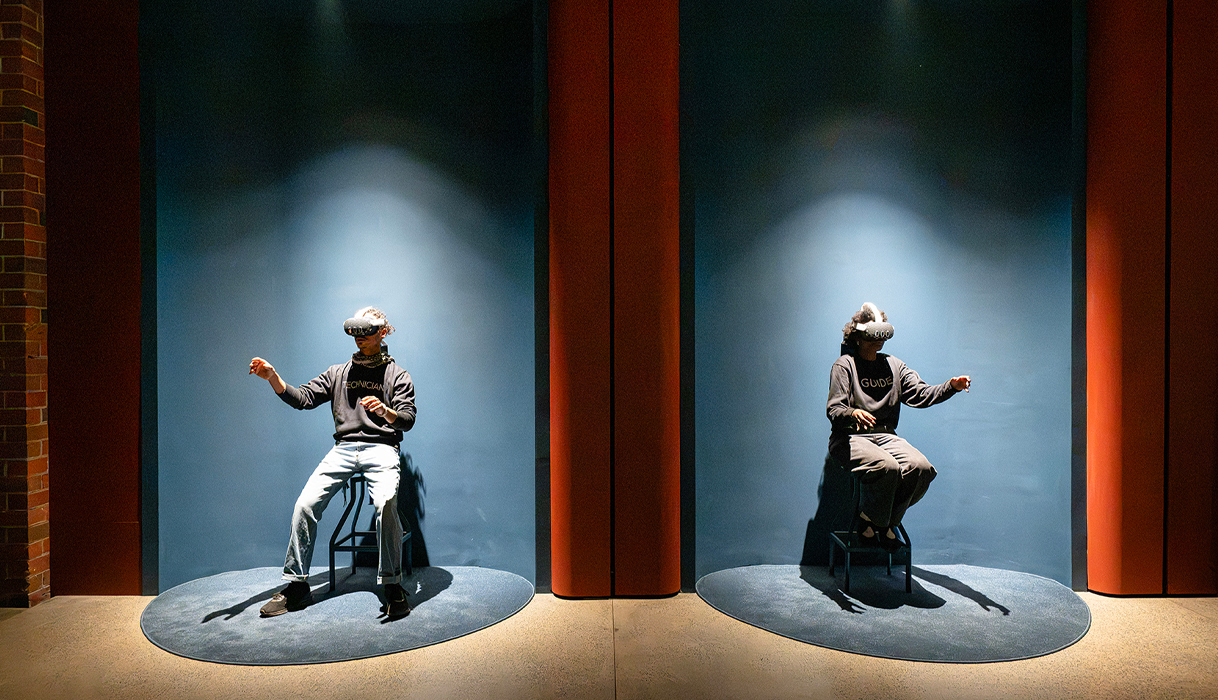
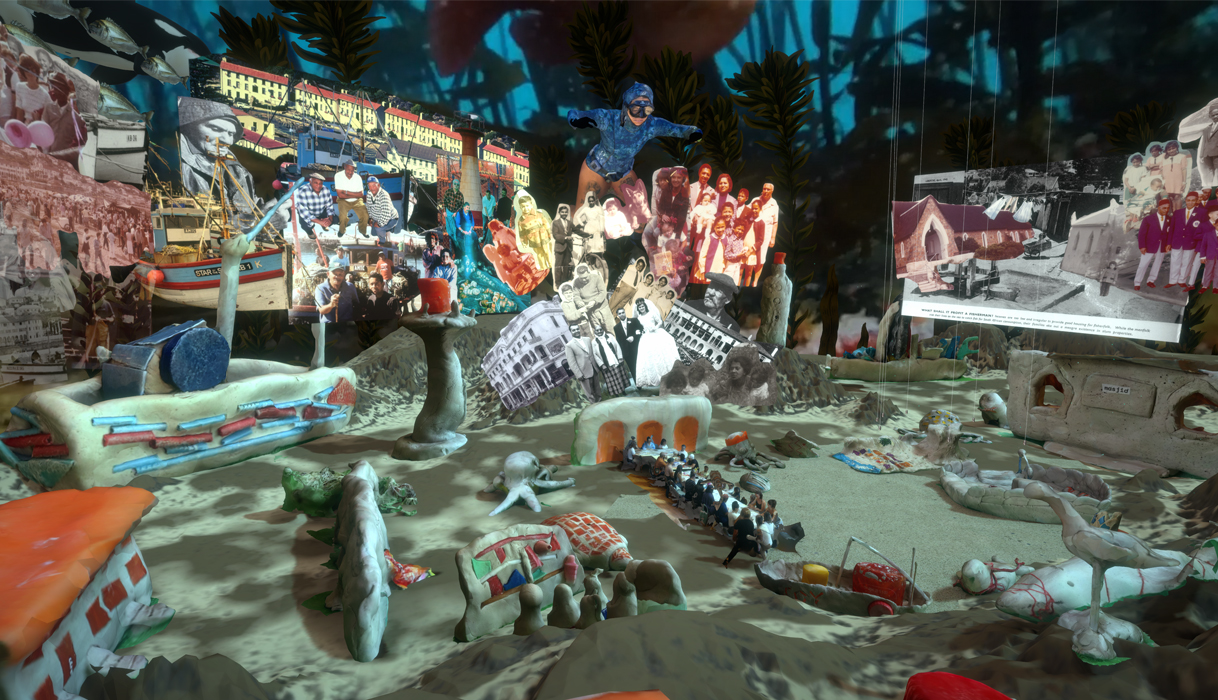
Installation views of Place showing Georgia Munnik, Concrete Jasmine (2026) and The Strangling Fruit (2026). © Georgia Munnik; Paula Gaetano Adi, Guanaquerx (2024). © Paula Gaetano Adi; and viewers experiencing Traci Kwaai’s VR installation Fisher Child (2025); still from Traci Kwaai, Fisher Child (2025). © and courtesy Traci Kwaai in collaboration with Kyle Marais and Lo-Def Film Factory.
Photos Graham De Lacy, Anthea Pokroy.
Etel Adnan (1925–2021) was a Lebanese-American artist, poet and essayist. In 2014, she participated in the Whitney Biennial, New York, and in the same year a retrospective of her work was presented at Mathaf: Arab Museum of Modern Art, Doha, curated by Hans Ulrich Obrist. Since then, her work has been the subject of numerous institutional exhibitions internationally. Adnan’s work is held in notable collections including the Centre Pompidou, Paris; the Museum of Modern Art, New York; M+, Hong Kong; the Sursock Museum, Beirut; the British Museum, London; Tate, London; and the Solomon R. Guggenheim Museum, New York.
Cave_bureau, founded by Kabage Karanja and Stella Mutegi, is a Nairobi-based collective of artists, architects and researchers exploring architecture as a deep-time earth practice of social and ecological repair. Their work engages the anthropological and geological contexts of African settlements, addressing contemporary rural and urban conditions through research, drawing, storytelling, construction and performative interventions. The collective conducts studies of caves within and outside Nairobi as part of a broader investigation into pre-, post- and neo-colonial spatial conditions. Cave_bureau also collaborates with international schools of architecture through teaching and research initiatives, working to bridge traditional and contemporary forms of spatial knowledge. Recent exhibitions include the British Pavilion Geology Of Britannic Repair, the Venice Architecture Biennale (2023); the Sharjah Architecture Triennial (2023–2024); the Museum of Modern Art, New York (2024); the Louisiana Museum of Modern Art, Humlebæk (2023); Venice Architecture Biennale (2021); and the Guggenheim Museum, New York (2021).
Kate Crawford and Vladan Joler are artists, researchers and scholars working at the intersection of technology, society and visual culture. Crawford is a Professor at the University of Southern California, a Senior Principal Researcher at Microsoft Research, and the inaugural visiting Chair of AI and Justice at the École Normale Supérieure. Joler is an academic and researcher whose work spans critical design, data investigation and counter-cartography, with a focus on digital labour, algorithmic systems and networked infrastructures. Selected collaborative projects include Anatomy of an AI System (2018) and Calculating Empires (2025), the latter receiving the Silver Lion at the Venice Architecture Biennale (2025), the Grand Prize of the European Commission for Art and Technology (2024) and the Boghossian Art Prize (2024).
Paula Gaetano Adi is an Argentine interdisciplinary artist working in robotics, video and performance. Her practice explores the world-making capacities of technology and art through experimental and speculative approaches. She has exhibited internationally at museums, conferences and art festivals including the National Art Museum of China, Beijing; Matadero Madrid; Lentos Kunstmuseum, Linz; Ars Electronica, Linz; and the Getty Research Institute, Los Angeles. Selected awards include the Creative Capital Award (2023) and the Golden Nica at Ars Electronica in the category of Artificial Life and Intelligence (2025). She currently lives and works between San Juan, Argentina and Providence, Rhode Island, where she is Professor of Experimental and Foundation Studies and Computation, Technology and Culture at the Rhode Island School of Design (RISD).
Kamil Adam Hassim (1997–) is a transdisciplinary artist and researcher working at the intersection of art, science and Indigenous knowledge systems. His practice explores how unseen physical, cultural and social forces are mediated and made perceptible through instruments, environments and networked systems. His work draws on cosmology, particle physics and radio astronomy to develop installations and hybrid instruments that translate complex processes into embodied experiences. Hassim has undertaken residencies at major scientific institutions, including CERN, the South African Astronomical Observatory, the Southern African Large Telescope and the Square Kilometre Array. He is the founder of L-Infinity, a Southern African research platform supporting collaboration across art, science and technology.
Traci Kwaai is a sixth-generation Kalk Bay Fisher Child. She is a story keeper, decolonial ocean historian and social and ecological activist. Her work explores belonging and community through the voices of local fisher and other displaced Kalk Bay communities. By engaging with both elders and youth, Kwaai seeks to weave together the rich tapestry of histories, memories and experiences that define Kalk Bay, a fishing village with rich and complex cultural roots.
Ernest Mancoba (1904–2002) was an avant-garde artist who worked in sculpture, painting, drawing and printmaking. Born in South Africa, he left for Paris in 1938. After the end of World War II, he and Sonja Ferlov, by then his wife, moved to Denmark. Five years later, the family returned to France, eventually re-settling in Paris in 1961, where Mancoba lived to the end of his life. Mancoba’s work represents a unique synthesis of modern European art and African spirit. Having lived through some of the most traumatic periods of the 20th century, he believed that art could help us find common ground and reflect the ubuntu philosophy he often referred to: that one’s humanity is tied to the humanity of others. Solo exhibitions of his work have been presented at the São Paulo Art Biennial (2025); Centre Pompidou, Paris (2019); Iziko South African National Gallery, Cape Town (1995); the Johannesburg Art Gallery (1994); Københavns Kunstforening (Kunstforeningen Gl Strand), Copenhagen (1977); Fyns Stifts Kunstmuseum (Fyns Kunstmuseum), Odense (1977) and Silkeborg Kunstmuseum (Museum Jorn) (1977) among others. His work is in notable collections such as Tate Modern, London; Centre Pompidou, Paris; the National Gallery of Denmark, Copenhagen; Fonds National d’Art Contemporain, Paris; Moderna Museet, Stockholm; the Johannesburg Art Gallery; and Iziko South African National Gallery, Cape Town.
Georgia Munnik (1990–) is a visual artist, self-taught perfumer and pedagogue. She is currently pursuing a bilateral PhD in Visual Arts between the University of Stellenbosch and Hasselt University, Belgium. Working between South Africa and Belgium, Munnik is a sessional lecturer in the University of Stellenbosch Visual Arts Department, for which she developed the art history course, Re Scentualising the Museum: Telling History to the Senses, while also working from the Open Senses Lab at PXL-MAD School of Arts at Hasselt University, where she is developing her perfumery practice under the supervision of Peter de Cupere. She has undertaken residencies in Basel and Copenhagen and exhibited in South Africa and internationally. Recent presentations include the Investec Cape Town Art Fair (2026); WHATIFTHEWORLD Gallery (2026); and a solo exhibition at the Rupert Museum, Stellenbosch (2025–2026) following her receipt of the Rupert Museum Social Impact Art Prize (2022). Her work was acquired by Amazon Africa Headquarters (2024). Munnik launched her debut commercial perfume PHENOTYPE in 2024. Her second olfactory creation SPORRA will be released in June 2026. She continues to work on her sculptural and olfactory studio practices as a daily form of material and sensory meditation, concurrent to her PhD research and teaching.
Rebecca Potterton (1996–) is a freelance illustrator based in Johannesburg. She has a BA (Honours) in History from the University of the Witwatersrand (2020). In her capacity as illustrator and researcher for Counterspace Studio, Potterton illustrated for Architecture’s Now, Near, and Next published by the Solomon R. Guggenheim Museum; the Serpentine Pavilion, London (2021); and the installation After Image by Sumayya Vally/Counterspace as part of Liminal Identities in the Global South, JCAF (2021). She was commissioned to create the graphic murals for the Worldmaking exhibitions, Ecospheres (2024) and Structures (2025), and the series of illustrations, Remembering Tomorrow (2026), which appears in the Reverse Futures Reader and exhibition handout.
Yinka Shonibare (1962–) is a British-Nigerian artist whose interdisciplinary practice explores race, class and cultural identity through engagements with Western art history, literature and globalisation. He studied Fine Art at Byam Shaw School Art and received his MFA from Goldsmiths, University of London. Shonibare was nominated for the Turner Prize in 2004, and has since presented major exhibitions internationally, including a mid-career survey at the Museum of Contemporary Art, Sydney (2008) and Brooklyn Museum, New York (2009). He was elected a Royal Academician in 2013 and awarded a CBE in 2019. Shonibare was awarded the prestigious Whitechapel Gallery Art Icon Award in 2021. A major retrospective of his work opened at the Museum der Moderne, Salzburg in the same year followed by his co-ordination of The Royal Academy Summer Exhibition. Recent projects include solo exhibitions at the Serpentine, London (2024), and Foundation H, Madagascar (2025), as well as participation in the Venice Biennale (2024). His work is held in major collections worldwide, including Tate, London; the Victoria and Albert Museum, London; and the Museum of Modern Art, New York.
Wolff Architects is a design studio concerned with developing an architectural practice of consequence through the mediums of design, advocacy, research and documentation. The Wolff team is led by Ilze and Heinrich Wolff who work collaboratively with a group of committed and engaged architects, creative practitioners and administrators. Heinrich Wolff has received many awards including the Daimler Chrysler Award for Architecture (2007) and the Lubetkin Award (2005). In 2011 he was elected Designer of the Future by the Wouter Mikmak Foundation. Ilze Wolff has a Master of Philosophy in Heritage and Public Culture from the African Studies Unit, University of Cape Town. She co-founded Open House Architecture in 2007, a transdisciplinary research practice which she continues to direct parallel to Wolff.